What's it really good for?
Today's topic is coconut oil.
This Coco craze of Coconut oil can make you gogonut crazy. Everywhere you look
coconut oil is good for this and that and who needs anything else besides
coconut oil? I am sure if I looked hard enough I could find somewhere on the
"internut" that I could replace the gas in my car with coconut oil.
It's good for everything right but my question is why?? So I will post some of
the amazing links of the 10000000000000000001 ways to use coconut oil and tell
you about some of my favorite uses for it and then I will find out why, why is
it good for all of these things?? This I am pretty sure I will edit and edit
and add and add to.
I guess I can start with my
personal uses of coconut oil.
1. I use it in the shower for
shaving my legs and "other" parts. I also use it in my hair when i am
going to take a nice long shower I will put it in my hair first before I
shampoo let it sit there while i do the restof my business, wash and condition
as normal.
2. I use it in the kitchen I
stopped buying spray oils a long time ago. Ya know when i was a kid they didnt
have those and mom would make me shorting cover baking pans and whatever else.
same idea.
3. Toothpaste: coconut oil baking
soda and some peppermint EO
4. House soap for the laundry, If
you make your own soaps coconut oil with zero superfatting. cure and shred. I use
it in laundry soap.
Off the top of my head besides
all of my products that contain coconut oil that's a start.
NOW a few Links
http://wellnessmama.com/5734/101-uses-for-coconut-oil/
Ps I love her Blog all together I
get lots of good stuff from her blog.
Some of these are awesome too.
http://greatist.com/health/genius-ways-to-use-coconut-oil
Ok so lets get to the dirty what
is coconut oil and why is it good for you?
For our
insides.
Nutritional
breakdown of coconut oil
According to the USDA National Nutrient Database, one tablespoon of coconut oil contains 117 calories, 0 grams of protein, 13.6 grams of fat (11.8 saturated, 0.8
monounsaturated and 0.2 polyunsaturated) and 0 grams ofcarbohydrate (0 grams of fiber and 0
grams of sugar). It provides little to no vitamins or minerals.
Coconut oil is becoming more of a staple cooking oil in many households. There are claims that coconut oil can do everything from supporting weight loss to slowing the progression of Alzheimer's disease.
Coconut oil is made up of
100% fat. However, the structure of fat in coconut oil differs from the
traditional saturated fat often found in animal products (primarily comprised
of long-chain fatty acids).
Coconut oil has an unusually high amount of medium-chain fatty
acids or triglycerides (MCFAs or MCTs), which are harder for our bodies to
convert into stored fat and easier for them to burn off than long-chain fatty
acids or triglycerides (LCFAs or LCTs).
Tom Brenna, a professor of nutritional sciences at Cornell
University's College of Human Ecology, states that all coconut oils are not
created equal.4 Partially hydrogenated coconut oil is
just as harmful as other highly processed oils containing trans fat and clearly
wreaks havoc on our health.
The second type, refined
coconut oil, is extracted from chemically bleached and deodorized coconut meat.
Virgin coconut oil, on the other hand, is extracted from the fruit of fresh
mature coconuts without using high temperatures or chemicals, is considered
unrefined and may paint an entirely different story for our health.
According to the Academy of Nutrition and Dietetics,
virgin coconut oil has potential antioxidant properties due to certain plant
nutrients it contains called phenolic compounds.5
article http://www.medicalnewstoday.com/articles/282857.php
For Your Skin.
"The question is, what makes coconut oil so beneficial for
the skin? Before we can understand how coconut oil achieves all of its
impressive benefits that people around the world claim, let’s look into the
constituents of coconut oil and their respective properties that might make
them useful for maintaining skin health.
Coconut Oil-
Composition
Saturated Fats: Predominantly, these
saturated fats are medium chain fatty acids or triglycerides. When applied on the skin, they keep it smooth to the touch.
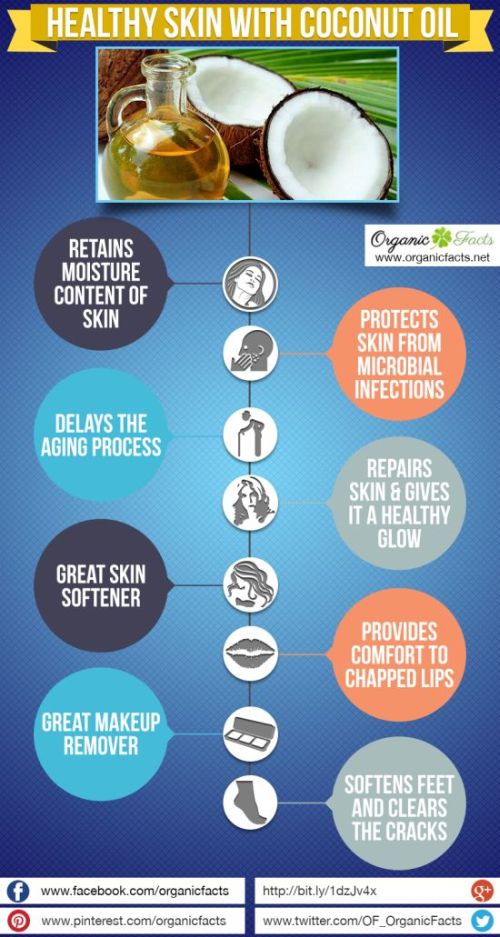
Due to the presence of these fats, coconut oil also retains the moisture
content of the skin, as the fats eliminate moisture loss through the pores on
skin. When ingested through the regular consumption of coconut oil, these fats
deposit under the skin, thus keeping it healthy and smooth, giving it an even
tone and reducing the appearance of the pores.
Capric /Caprylic/Lauric acid: These are not very
different from the medium chain fatty acids, but it is still important to
mention them separately here, since they have their own contributions. These three fatty acidshave strong disinfectant and antimicrobial properties. As a
result, when applied on the skin, coconut oil protects from microbial
infections that can get into open wounds or even enter the body through the
pores. This microbial action can be experienced even if coconut oil is taken
internally, as the fatty acids boost the immunity when converted to monocaprins
and monolaurins.
Furthermore,
capric, caprylic, and lauric acids are easily broken down chains of fatty
acids, meaning that they contribute to usable energy in a quick and efficient
way. This can be a major boost to your energy levels before a workout, which
is why these powerful acids have also been linked to weight loss and
management. Losing weight is a good way to improve the quality of your skin by
reducing excess fat, stretch marks, and folds in the skin which can be
unattractive. Having a healthy, toned body means that the skin maintains its
tight grip around the muscles and bones.
Vitamin-E: The contributions
of vitamin-Etowards skin care are well known. It
is essential for healthy skin growth, repair of wear & tear on the skin,
keeping skin smooth and protecting against cracking. Above all, it prevents
premature aging and wrinkling of the skin, since it has good antioxidant
properties. 100 grams of coconut oil has about 0.1 mg of vitamin E,
thus enhancing it skin-nourishing properties.
Anti-Aging Cream: Traditionally,
coconut oil has been praised and popularized for its anti-aging properties.
Proteins: Like coconuts themselves, coconut oil
is rich in many proteins. These proteins keep skin healthy and rejuvenated,
both internally and externally. Proteins also contribute to cellular health and
tissue repair, along with a wide range of other essential activities within the
body. For any damaged cells on or near the skin, a healthy of flow of proteins
guarantees their replacement at a normal rate, whereas people with
protein-deficient diets heal slower and often develop more obvious scars due to
the extended healing time.
The best property of coconut oil that makes it so beneficial for
skin is that it does not become rancid. When you apply it on the skin, it can
work for a longer time, unlike many other oils, without it getting rancid. Due
to these various beneficial properties of coconut oil, it is used as an important ingredient in several skin care
creams."
Complete article
https://www.organicfacts.net/organic-oils/coconut-oil-for-skin.html
This was also a great article.
http://authoritynutrition.com/why-is-coconut-oil-good-for-you/